1899 missed the Roomba
I watched a YouTube video the other day about whether Anthropic made the indie hacker obsolete. It reminded me of a lot of similar articles I read on Medium over the last couple of years. They all share the same line of thinking: writing code gets taken over by AI. I don’t doubt that, but the prediction itself bores me since it misses the actual innovation.
In 1899, French artists tried to imagine day-to-day life in the 21st century.1 When looking at these images, I find it striking how strongly the artists’ present-day experiences shaped their visions of the future. Take the following image as an example.
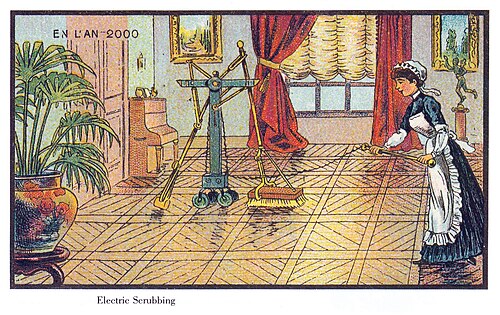
It shows a maid operating a remote-controlled electric floor scrubber. Instead of a human pushing the scrubber, a machine does the pushing. The task itself stays exactly the same. While the general prediction remains true (a machine does the cleaning), the artists missed an important part of the actual innovation. Nobody operates a Roomba. It runs on its own.
I don’t blame the artists for that miss. Our imagination often stays within the confines of the current technological capabilities. They had never experienced autonomous robots or wireless control. They had experienced scrubbers, cables, joints, and hydraulic cylinders.
The same series has a second card that has aged a little too well.
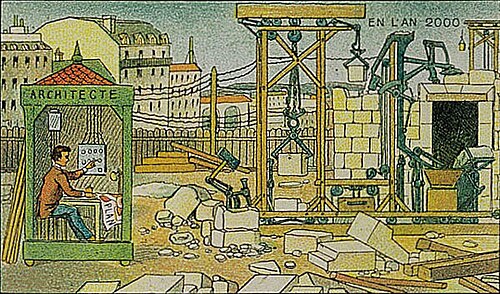
It shows an architect operating remote-controlled construction machinery on a building site. Now if you replace the construction site with a computer and put the word software before architect, you get how more and more people picture software engineering today.
Instead of humans writing code, humans instruct AI to do so. The human acts as a controller, just like the maid operating the cleaning device. But do we already think of this as the innovation? Or did we again simply hand over a manual task to a machine?
I don’t know. The future consists of things we have not experienced yet. If I had to guess, the next chapter takes the architect out of the booth and makes the process self-operating. Which is probably exactly the kind of guess someone would make in 1899 2026.
Footnotes
-
Armand Gervais, a French toy manufacturer, commissioned them for the 1900 World’s Fair in Paris. You can visit publicdomainreview.org to take a look at them. ↩